
Lecturer: Alberto Usón, Institute for Particle and Nuclear Physics at the School of Physics and Astronomy, University of Edinburgh.
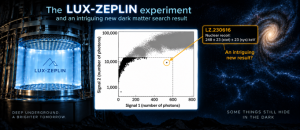
Abstract: The nature of dark matter remains one of the biggest mysteries in modern science. With plenty of different possible candidates and a wide mass range, Weakly Interactive Massive Particles (WIMPs) usually rises as one of the most promising candidates. The direct detection experiment LUX-ZEPLIN (LZ) primarily searches for WIMPs using 7 tonnes of active liquid xenon at the Sanford Underground Research Facility (South Dakota). With this technology, LZ has demonstrated world-leading sensitivity to a wide range of dark matter models. A new analysis from LZ searching for effective field theory and inelastic models of dark matter identifies a single nuclear recoil candidate at 248 keV, in tension with the background-only hypothesis at a global significance of 2.6σ. Whilst this is far from constituting a detection, the event is nevertheless intriguing.
In this seminar, I will give an overview of the analysis, discuss the relevant high-energy backgrounds, and explore the wider implications of the event for dark matter searches. I will also introduce how the LZ detector works and highlight some of the other experiment’s most recent results, including the observation of solar neutrinos through Coherent Elastic neutrino-Nucleus Scattering and our latest search for more conventional WIMPs.
Thursday, October 1, 2026, 12:00 – Nuclear Physics Seminar.